Contract Mint

The Future of Freelance

  • Resources
  • Blog
  • Contact
  • Get your contract

6 Do’s And Don’ts Of Good Freelance Contracts That Every Freelance And Employer Must Consider

what a good freelance contract must contain

The world of freelancing is full of risks on both ends, avoiding the paperwork is one of the biggest advantage of freelancing but a simple yet effective freelance contract can make a huge difference. It doesn’t have to be complicated, it doesn’t have to be confusing but you can make a comprehensive and clear contract without much trouble. Additionally the benefits such contracts offer, are worth the little effort.

There are tons of freelance contract templates available and you can draft one yourself; all you have to do is consider few things while doing that. Following are some do’s and don’ts you must remember while drafting a contract for freelancing.

The fundamentals

The contract must include two basic things; “who” and “what”. The “who” part defines both parties and obviously the “what” part defines their roles. Even if everyone knows his role and responsibilities, it doesn’t hurt to put that in writing. This is standard part of the contract that defines the job in details. It also makes sure everyone is one the same page as everything is in writing.

Make sure the contract is simple. This is important because no one wants to change his role during the project. Of course you are the only one who knows what you can do and what you can’t. Be specific with the client when informing him about your strengths and weaknesses when it comes to particular skills.

Deliverables

The freelance contract should define the deliverables, it should define the final outcome and what would be the final product. This would be extremely useful from both ends. Lot of mess could happen especially in technical work; for example if the client and freelancer are using different operating systems or platforms then the file type of final product could create a problem.

That’s why it is helpful to include delivery details in the contract; it should define what kind of final product you will deliver and what file type you will use. Keep it simple; you don’t need to send all the work related files to the client if you are not asked to.

Deadline

This is probably the most important part of the freelance contract. The contract must define the deadline for the project or milestones. It is better to define the time frame of different parts of the projects to keep thing manageable and understandable for both parties. For example it is better to define that module A would take 4-5 days and module B would take 7-9 days rather than saying the whole job would take 20 days.

The purpose of freelance contract is to make things easier while protecting both parties at the same time. It doesn’t need to be complicated and it doesn’t need to be unrealistic. Both parties must understand that everything could not possibly be predicted and things could go wrong. So, make sure there is enough room for improving things even if the first version fails. Time zone differences could affect the overall time frame too; for example a client or freelancer can take few hours to respond to a query. So consider that factor too while defining the deadlines.

The payment

Here comes the scary part, however it is not as scary as it seems and you can neutralize the risks (or at least minimize them) by implementing few rules and regulations. Of course everyone knows the payment details but putting those details in writing is the least you could do. Make sure you define everything regarding the financials in freelance contract. It should define the payment method (PayPal, bank transfer etc.), the billing method (fixed price job or on per hour basis) as well as everything you can think of.

Depending on what platform you are using (or even if you aren’t using any) you can define cancellation clause and upfront payments. Initial deposit is not a common practice because of the obvious reason but interestingly it can benefit clients too by making sure the freelancer remains committed to the project.

Revisions

It is not that easy to define how many alterations, modifications and revisions initial fee covers. Plus, it varies depending on the nature of the job, milestones and the overall work. However you can state the basic structure for possible modifications and revisions to ease both parties. It is all about the professionalism and your commitment to the job, in some cases you don’t even need to define this clause.

In other cases, it is better to define the revision or modification fee (if applicable). Freelance contract is meant to give both parties peace of mind rather than putting them in vulnerable situations. Additionally, in some jobs it is not possible to define the next milestone before completing the previous one, and it is also possible the previous task may need some modification because of the change in requirements by the client. So, agree on a reasonable price for revisions.

Copyrights

That is very important part of freelance contract because freelancing means the work could be done online and it also means the work could be copies easily. There are several different ways to make sure the copyrights of the final product or work remain in control of the intended party. For instance NDA (Non-disclosure agreement) that makes sure everything (including the work itself) remains confidential.

Adding a clause about the copyrights of the final work protects both parties because payment and copyrights of the work could be tied with each other in freelance contract. It means the client cannot use that work without paying for it first and the freelancer cannot use that work again after receiving the full payment of that work. Contrary to popular belief, the particular issue is not only related to the writing related work exclusively, but you should do that in other kind of work too like designing and developing.

 

Tips for Newbie Freelancers: What’s the Appropriate Amount to Propose?

what can i charge as a new freelancer


What’s a Photoshop noob worth an hour? How much should I propose for graphic or web design services as a start-up?

If you are just starting out in the industry, you may still have these questions at hand. You may feel reluctant to set your amount by thinking the samples mentioned come from senior designers. After all, the cost of a graphic designer increases over time.

Based on forums and surveys, the average rate of newbies are as follows:

$15 – $35 per hour – for the complete newbie who has a reasonable knowledge and skill on Photoshop

$65 – $85 per hour – has produced paid works and has a reasonable experience on graphics and web design with a team. Uses Photoshop or Illustrator for every work.

$75 – $95 per hour – has mastered Photoshop and produced paid works on his own. Can also do Photoshop tutorials.

Bear in mind that this is just the general range that novice artists make and clients agree to pay for. These prices will help get your name out in the market while ensuring you don’t get underpaid.


Graphic and Web Design Business Tricks: Avoid Getting Stiffed

It is bad enough to get lower pay when you are starting out. But to get stiffed after completing work fast is a misfortune that every artist dreads.

Steer clear of this trouble by knowing these tricks to secure your hard-earned graphic artist/designer salary:

Require a Deposit

Are you charging a deposit before taking in a project?

Asking a deposit gets rid of untrustworthy clients right away. As with your service rates, the deposit amount may also vary according to the project. For example, a $500 project may require $200 to $250 deposit.

Generally, a 50% deposit serves as a secure payment for the artist. For big projects with extensive scope and bigger charge, the deposit may be lowered down to 25%-30% of the total price. Clients who refuse or complain about deposit charges are bogus customers. Be firm with the deposit and you can weed out the phony clients from the credible ones.

Require a Contract

Another way to gain solid security for your transactions is through a contract. Get an airtight graphic design contract from experts.


The Graphic Design Proposal Template for Gifted Freelancers


Contract Mint provides specialized contracts for different lines of freelance work. These contracts clear out uncertainties and highlight gray areas for your client’s legal obligations. A generic contract you can download for free may not cover your needs and rights as a graphic artist. That is why you need one that can cover the loopholes and also get you a stress-free and the most lucrative transaction.


Where to Start Salary Negotiations as a Graphic Designer

You grow in your craft with every project you work on. You hone your skills, gain experience, and acquire more clients. It is only reasonable to get a higher pay as you develop your skills. If you are wondering where to start salary negotiations as a graphic designer, take a look at your projects at hand and the urgency they demand.

If your working schedule has been fully booked for three solid months but more projects are coming in, it is time to raise your rates. This is the perfect time to uncover your market value.

How much should newbie freelancers charge for their services? Knowing the average hour price of both novice and senior designers will give you a framework to base your own professional fees.

Get Tips for Setting Rates from Established Designers

how much should I charge as a freelancer

Now that you have learned about setting rates for your freelance work, the question remains: How much should you charge for design work?

Take a look at how much other designers are charging in the market. This gives you an idea on what is a reasonable hourly rate for a senior graphic designer.

Knowing these concrete figures will give you tips for setting rates for your own work.

Go Media, an in-demand design firm in the market, shares that the company has varying rates depending on the service they offer. The company reveals that design work costs $100/hour, develop work is at $125/hour, and consultancy costs $65/hour.

A New York based designer, Sophia Chang, revealed that her work is quoted the same way. However, she shared that she also takes into account the type of client. Chang said that her fees for graphic and web design, illustrations, project management, and consultancy are all different and vary according to the asking client. The bill for a small start-up business is not the same as that for a big corporation. Generally, the rates are between the range of $80 to $200.

Hey Monkey! Designer Lenny Terenzi has a different approach for estimating graphic design bundled hours. He says that generally, he calculates his work for $75 per hour. However, when he does project proposals, he uses flat rates for specific categories of his work.

For example, a $2,000 logo design or print project may include the following quotes:

  • $700 Graphics Designing
  • $700 Creative Concept. This includes:
    • Sketches
    • Wireframes, and other work needed for concept creation.
  • $300 Project Management
  • $300 File Preparation and Delivery. This encompasses:
    • Small style guides
    • File formats

Having these ideas gives you sufficient background on how to calculate hourly freelance rates for web design, graphic illustration, consultancy, and management.

What Can I Expect To Earn As A Contract Graphic Designer

earning expectations of a contract freelance graphic designer

As with any freelancer’s service charges, the graphic design hourly rate is affected by many factors. These factors may include the artist’s years of experience, location, level of education, and the scope and length of the project at hand.

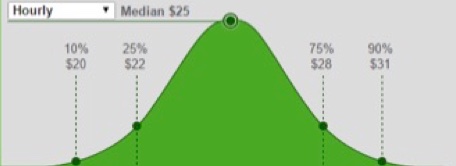
In order to set out with your own design rate per hour, it is important to have a background of how much people on the same field are earning. This way, you can ensure that you are not charging too much or too little. Below is a sample of hourly rates you can use as framework for your own service charges:

salary expectation of a graphic designer

Designer’s Hourly Rates: Pricing Design Work

In order to help you set out with your own service appraisal, use this free worksheet by Marketing Mentor.

Take note though that location is another factor that affects the service fees. According to the Survey of Salaries and Billing Practices for the Communication Design Industry, the average graphic design services worth for Canadians is $74/hour. This study has been conducted on 2,890 creative specialists across Canada.

Graphic Design Hourly Rate Considerations

This industry is teeming with various offers, skill levels, and experience. Because of this, there is no cookie-cutter way to compare prices for designers’ hourly service fees. However, you can still ensure that you get the best value for your work by keeping in mind certain considerations. In order for you to establish a price as a contract graphic designer, make sure that you consider these factors:

  • The range of the proposed project at hand. This includes:
  • Deliverables
  • Volume of work
  • Number of concepts both from you and the client
  • Possibility of future business
  • Number of revisions you will allow
  • Estimated expenses
  • The urgency to deliver the project
  • Anticipated number of hours you need to complete the project

Take note that the rate you quoted to the client at the start of the project may change should there be any changes outside of your allowable revisions. You need to make sure that the client understands this condition.

During the course of the project when you need to add extra features or if the project calls for a new idea on a different route, it is crucial to communicate this to the client. You do not want to pour out your new ideas only to have the client refuse to pay for new rate.

Graphic Design Hourly Rate 101: Your Guide to Getting the Most from Your Work

Time is money.


make sure you are getting paid right as a freelancer


This is especially true for freelancers who get paid by the hours they put in or the project that they finish. Graphic design is one of the most in demand freelance stints today where competition is tough. As a freelance graphic designer, it is important that you get what your time, work, and talent are worth.


Why Graphic Design Hourly Rates are Tricky

When you are a full-time employee, your company would take care of taxes, health care, licensing, and other business essentials. Usually when the employee receives their pay, it has already been calculated so that what they get is only their net worth.

This is not the case for freelancers.

As a self-employed worker, you need to take care of taxes, health care, and other necessary payables as prescribed by law.

The amount you charge for your work may not also be the same for all projects that you take under your wing. This rings true especially for people in the graphic design field. Each project is unique and comes with a different set of targets and expectations and rules from the clients. Every project you design will demand different amounts of time and test your skill and talent in different levels.


Hourly vs Per Project: A Graphic Designer’s Dilemma

One of the first dilemmas that may derail you when setting charges for your services is whether to go for hourly or per project rates. Once you get settled on what works best for you, it becomes easier to pinpoint what constitutes your service fees.

Graphic Design Rates per Project

The Upside:

Getting paid for every project you work on means you don’t need to watch out for the amount of hours you put in. Graphic designing is creative work. And for people who are committed to this craft, it is easy to get carried away and lose track of time. This is a no-no if you are paid by the hour.

With a per-project payment basis, it is more convenient to switch back and forth between projects without having to keep a close eye on how many hours you invested. Being conscious of this can even interfere with one’s work because the artist cannot be fully immersed into their creative zone.

The Downside:

The downside of per-project payment for graphic design is that you need to quote a price even before you started. There is no knowing how much work a project will demand out of you. You may overrate or underrate a project and find out later that it demanded little or more of your effort and time. This miscalculation may be most common for novices.

Another disadvantage is that you need to provide a timeframe to your client in terms of when you can finish the project. This is later translated into a quote which the client accepts or refuses. Because of this set time frame, you need to be rigid as to meet the deadline that was agreed upon. Otherwise, you may ask for extra time and may need to come up with a new quote. Remember that your performance, in addition to your actual finish work, will also be a deciding factor on whether clients will be repeat patrons of your work.

Graphic Design Rates per Hour

The Upside:

Getting paid based on the hours you put in is the most straightforward payment term in graphic designing. This is the safest route because the designer is salaried in the traditional way. When things get sticky with your project and you need to put in extra time to finish, you are sure to get paid for the extended hours.

Getting paid by the hour also means not having to worry about scrimping your work to fit in a timetable of deadline. You do not have to compromise the quality of work just to make sure the deadline of submission is met. As a creative worker, you get more freedom to focus on the project itself and get into the zone of creating rather than regularly check if you still have enough time left.

This luxury of freedom affords you to tap on your creative side more closely and produce a project where you pour in as much skill and talent without being bothered by schedules.

The Downside:

Before you decide to get paid by the hour, you need to decide how and what constitutes a work hour that your client will pay for.

This can get a bit tricky. Do you count your lunch hour and break time? Is the amount of time spent researching also gets billed? Clients may also have their take in terms of what constitutes your work hour. They want to ensure that the hours they pay you for are only for the time you spend on their projects and not on anything unrelated. When naming your price, such as $75 or $100 per hour, the clients may feel this to be steep as compared to when you quote a price for completed work.

Weigh your options by knowing what kind of project you have at hand. Does it require research? Is it a big project that will map out for months? For such cases, it is wiser to charge per hour. If in doubt, get a freelancer agreement that gets you covered.


  • « Previous Page
  • 1
  • 2
  • 3
  • 4
  • …
  • 8
  • Next Page »
  • Graphic Designer Contract
  • Motion Graphics Contract
  • Image Licensing Contract
  • Web Developer Contract
  • Photographer Contract
  • Music Artist Contract
  • Ilustrator Contract
  • Writer Contract